


Not Just NPS®: How a Large National Retailer Turned the Voice of the Customer into a System for Change
For Large Businesses, Measuring Satisfaction Alone Is Not Enough
When a large national retailer with hundreds of retail locations approached us, the company already had customer data, service initiatives, and a strong operations team. Internally, the business was already working with customer journey maps, a service vision, and individual surveys, while store managers were sharing many observations about the customer experience with the head office. But the company understood well: having a loyalty program and a large customer base does not yet mean that the business is truly managing loyalty.
We often see similar situations not only in retail, but also in banking, telecom, logistics, and other service industries. At a certain point, individual surveys and data are no longer enough: the business needs a more mature approach to customer experience management.
Surveys That Do Not Trigger Action Do Not Improve the Customer Experience
The problem was not a lack of data. The company already had many customer signals and service initiatives. But if the business stops at the level of individual surveys, even critical problems can remain unresolved for years, even though they are well known both in stores and at head office. At the same time, the changes that do get launched are difficult to assess objectively in terms of their impact on customers or the business.
This is why, in this project, we were not talking simply about launching NPS, but about building a Net Promoter System as an operational mechanism for change. It was not about adding another indicator to reporting, but about creating a system in which each relevant piece of feedback becomes the basis for a concrete action at the level of a touchpoint, business function, or management loop.
Improving the Experience Is Impossible Without Understanding the Drivers of Loyalty
Before building the operational loop of the Net Promoter System, it was necessary to understand what exactly influences customers’ willingness to recommend the company. We started with a baseline loyalty study not only to establish the starting NPS score, but also to identify which factors truly determine loyalty.
The study showed that willingness to recommend is influenced most by service quality, product range, promotions, and price perception. For the retailer, this was an important transition from intuitive assumptions to a more evidence-based management model: instead of improving everything at once, the company could focus on the elements of the experience that have the greatest impact on loyalty.

Top-down NPS Is Not Enough for Management Decisions
After the baseline NPS measurement, we had an important picture, but one that was still not sufficient for action. At the top level, it became clear that the company should focus on at least two broad areas that influence loyalty: the attractiveness of promotions and staff performance at touchpoints. But this was not enough for concrete management decisions.
If we see that a promotion influences a customer’s attitude, we need to understand exactly what did not work: the promotional product was missing from the shelf, the terms of the promotion were unclear, or different mechanics were poorly combined. The same was true for service: it was important not only to see that staff performance influenced loyalty, but also to understand at which touchpoint, in which situation, and whose behavior led to the customer’s dissatisfaction.
This is why the priority elements of the experience had to be measured with enough granularity for the team to act. The next stage of the project was dedicated to designing the measurement logic: when to ask customers for feedback, what exactly to ask, and through which channel to collect the response. If you ask too late, the customer will no longer remember the details. If you ask too generally, the answer will not provide actionable input. If you choose an inconvenient channel, the business simply will not receive enough high-quality feedback.
From that moment, NPS began to transform from a metric into an emerging operating system for change.
For Customer Feedback to Influence the Business, the Right Question Must Be Asked at the Right Time
Once we understood what level of detail was missing for management decisions, the next step was to test the feedback collection architecture itself. In theory, the company could ask customers immediately after the interaction or after some time had passed, ask the classic question about willingness to recommend or focus on a specific visit, and use SMS, a QR code, a messenger, or an automated voice call. But to build an NPS system, it is not enough to choose the most obvious option.
The task is to find the option that produces the most accurate and, at the same time, most actionable signal.
During testing, we saw that delayed feedback collection works worse for operational management, because customers no longer always remember the details of a specific interaction well. We therefore began to shift the focus toward more “hot” feedback tied to the last contact, and to test channels that make it possible to collect a response quickly. One of the most practical solutions was an automated voice call, which delivered the highest response rate among the channels tested.
Similarly, the classic question about willingness to recommend the company proved useful for understanding the overall attitude toward the brand, but it did not always explain precisely enough what had happened in a specific interaction. For operational management, in many situations it is more useful to ask about the specific experience of the last contact than about general willingness to recommend a brand.
Customer Feedback Should Reach the Person Who Can Actually Eliminate the Cause of the Problem
When the logic of measuring and collecting feedback became clearer, the next task was to integrate it properly into the management loop. For us, it was fundamentally important not to create the false impression that all customer experience problems originate at the frontline and that the frontline team should be responsible for all feedback. In large retail, this is not the case.
Some problems do indeed arise at a specific touchpoint: for example, when a consultant was not attentive enough, the checkout queue was too long, or the store team did not ensure that a promotional product was available on the shelf. But a significant part of the customer experience is shaped by decisions made far beyond the store.
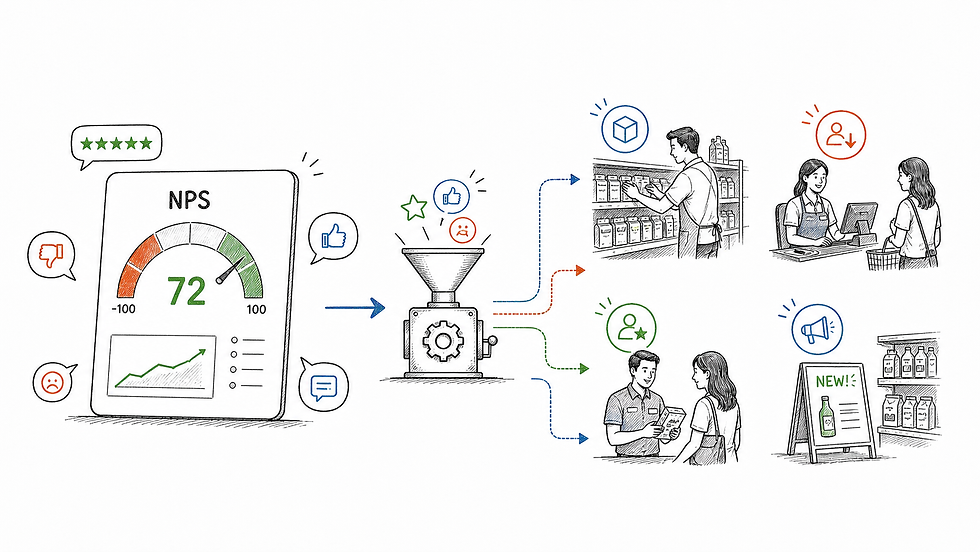
This is why we built the system so that each type of feedback reached the department that could actually influence the cause of the problem. If a customer complains about staff behavior or a specific situation at a touchpoint, this signal should go to the store manager or operations manager. But if the problem concerns a promotion, it is not enough to simply record it in the store or pass it on to the customer experience lead.
This kind of feedback should be received by the marketer, trade marketer, or category manager responsible for the promotion mechanics, communication, product availability, and how promotional tools are combined. Only when feedback is routed to the right process owner does the voice of the customer start working not as a signal to be merely noted, but as a tool for real change.
Without Automation and Training, NPS Does Not Scale
Once the measurement logic, routing, and feedback collection channels had been defined, the next step was to scale this model across the entire network. In large retail, the Net Promoter System cannot work as a manual process: there are too many touchpoints, customers, and signals that need to be collected quickly, classified correctly, and handed over for action. Automation therefore became an important part of the project.
The team needed to set up a mechanism in which the system automatically launches a survey after a relevant contact, collects the response, records the problem, and sends it to the responsible department. But it also quickly became clear that automation alone guarantees nothing: if teams do not understand how to work with the new feedback flow, signals begin to get lost not in spreadsheets, but inside the digital process.
This is why we combined automation with training from the start. Store managers had to learn not only to see the score, but also to understand when to handle the issue themselves, when to escalate it further, and how to handle customer feedback appropriately. Functional teams had to get used to the fact that customer feedback was no longer an occasional insight, but a regular management signal.
As a result, the client received not only the technical infrastructure for collecting and transmitting feedback, but also a new working practice in which the voice of the customer became part of daily management rather than a separate research activity.
NPS Becomes Part of Regular Management, Not Just a KPI
When the system for collecting, routing, and processing feedback began to operate regularly, changes took place not only at the operational level, but also at the management level. NPS stopped being just a metric periodically reviewed by the customer experience team and became a shared language for different business functions. Store managers began to see not only their own operational tasks, but also customer signals requiring a response.
Functional teams received a regular flow of feedback on the decisions for which they are responsible. And for senior leaders, NPS became a tool that helps determine priorities for change in a systematic rather than intuitive way.
At the same time, we did not treat NPS as a KPI that could simply be quickly cascaded across the entire organization. For the indicator to become part of the management system, the business first had to learn how to read it correctly, distinguish systemic problems from local ones, understand statistical limitations, and see the specific reasons behind the number. Only then can NPS become a useful element of the management model rather than a formal indicator used to put pressure on teams.
As a result, the company received not just a new feedback collection mechanism, but a way to scale the network without losing its leadership in customer experience: without overinvesting in wow-service, and by investing specifically in the areas that truly matter to customers.
Net Promoter System Becomes a Tool for Real Change in Complex Service Businesses
This case clearly shows that the value of the Net Promoter System lies not in the metric itself, but in how the business works with it from that point onward. If NPS remains just a number in a report, the company gets another indicator with no real impact on the customer experience. But when measurement is combined with the right level of feedback granularity, routing to real process owners, automation, and new management practices, feedback begins to work as a tool for change.
This, for us, is what implementing the Net Promoter System is about: not simply calculating loyalty, but transforming the voice of the customer into actions, priorities, and decisions.
This approach is especially valuable for companies with a large network of touchpoints, a complex internal structure, and a high cost of error in the customer experience. For retail, banking, telecom, logistics, and other service businesses, the Net Promoter System becomes a way not only to collect feedback, but also to scale the business without losing manageability.
Especially when the company already has a lot of data and individual service initiatives, but needs a holistic system that helps identify problems faster, assess changes more accurately, and invest in exactly those elements of the experience that truly matter to customers.


Comments